Women in Manufacturing: Honoring Their Legacy During Women’s History Month
March is Women’s History Month, a time to recognize the women who helped build, design, and transform manufacturing in America. Their contributions are not side notes in history. They are foundational to the industrial world we operate in today.
Long before modern automation and AI, women were engineering solutions that changed entire industries:
In 1867, Margaret Knight invented a machine that automatically produced square-bottom paper bags, an innovation still used today. In the 1920s, civil engineer Olive Dennis designed bridges and transportation infrastructure that strengthened supply chains and industrial expansion.
Chemist Stephanie Kwolek invented Kevlar, a high-strength synthetic fiber used in aerospace, tire manufacturing, and industrial safety equipment. Computer scientist Grace Murray Hopper developed the first compiler, laying the groundwork for modern programming languages. Hedy Lamarr co-created frequency-hopping communication technology, the precursor to Wi-Fi and Bluetooth.
Why name these incredible women? Because they demonstrate the many ways women have shaped manufacturing, engineering, and industrial innovation. They didn’t just participate in the industry. They advanced it.
When Industry Needed Women Most
The large-scale shift of women into manufacturing began in 1917, when the United States entered World War I. Millions of men left factory jobs to serve overseas. Production demand surged, plants faced critical labor shortages, and women stepped in.
They worked in steel mills, munitions plants, textile factories, and shipyards. They inspected parts, operated machinery, assembled components, and supported distribution systems. Despite doing essential work, they were paid significantly less than men.
Their impact was undeniable. The Department of Labor established Women in Industry Services to improve standards and study working conditions for female industrial workers. During this era, women proved their technical capability at scale.
In 1920, women gained the right to vote. While the suffrage movement had long been underway, its visible industrial contributions accelerated cultural change.
World War II and the Manufacturing Workforce
History repeated itself during World War II. As men deployed, factories once again depended on women to sustain wartime production. “Rosie the Riveter” became a national symbol of female strength in manufacturing, with more than 310,000 women working in the aircraft industry alone. Women filled roles in automotive plants, heavy equipment manufacturing, and defense production across the country.
When the war ended, many women were pushed out of those jobs, but something had changed permanently. They had demonstrated skill, resilience, and technical ability in high-pressure industrial environments. Essentially, manufacturing was no longer seen as exclusively male.
Women in Modern Manufacturing and STEM
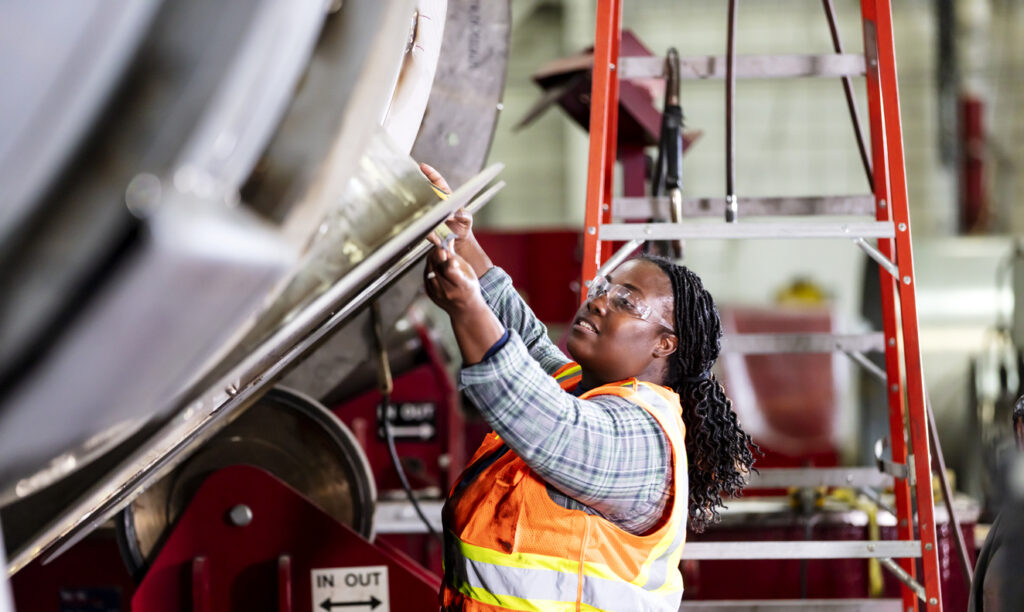
Since the 1970s, women have steadily increased their presence in manufacturing and skilled trades. Today, they represent just under one-third of the trade’s workforce, and that number continues to grow.
At the same time, the number of women earning degrees in STEM fields has risen significantly. This matters because modern manufacturing demands technical expertise.
Factories today rely on:
- Robotics and automation systems
- CNC machinery and precision controls
- Industrial electronics and control boards
- Advanced materials and AI-driven processes
These systems require skilled professionals who can program, troubleshoot, diagnose, and repair complex equipment. Women are not new to these environments. They have been solving industrial problems for more than a century.
Why Representation in Manufacturing Matters
Manufacturing remains a backbone of the U.S. economy. It supports supply chains, drives innovation, and creates high-value careers. As experienced technicians retire, the industry faces a growing skills gap.
Encouraging women to enter industrial and technical careers is a must; Diverse teams strengthen operations, different perspectives improve troubleshooting, and broader recruitment pools solve labor shortages. In sectors like automation, robotics repair, and industrial electronics, precision and critical thinking matter more than ever.
The future of manufacturing depends on skilled people, regardless of gender, who are willing to innovate and adapt.
Celebrating Women in Industry Today
Women’s History Month is more than a celebration of the past. It is a reminder of what continues today:
- Women built machines that transformed commerce.
- They engineered materials that protect lives.
- They developed technologies that power modern communication.
- They kept factories running during global crises.
At Industrial Repair Service, we recognize the impact women have on manufacturing every day. From technicians and engineers to account managers and operations leaders, women help keep production lines moving and systems performing at their best.
Manufacturing has never been shaped by one voice alone. It has always been strengthened by collaboration, expertise, and resilience. This March, we honor the women who built industry, and the women who continue to lead it forward.